All work AI · Agentic Prototyping · Ford

Building my own AI — agentic tools, not just mockups

I taught myself to build real AI applications — an agentic assistant that creates valid vehicle-data templates from plain language, a grounded help agent that answers from internal docs with citations, and a reusable method that lets any designer generate working prototypes in hours. Not concepts. Working software.

Role

Product Designer — research, design, build, present

Timeline

2025–2026

Platform

CVDE / UVMI (internal Ford)

Stack

Python · FastAPI · Google ADK · Vertex AI Gemini · RAG · React/Next.js

Weeks → Days
prototyping cycles
Hours → Min
template creation
Production
a shipped AI tool, not a mockup
Org-wide
reusable method, no coding
AI template assistant conversational interface
The AI template assistant — plain-language intent in, a valid monitoring template out. (De-identified.)
Why I built these

Prototyping was a relay. I wanted to close the gap.

I wanted to put working prototypes in front of real users myself, in days, and hand engineers something far more precise than a mockup.

Prototyping was a relay: requirements → hand-built Figma screens → wait for an engineer to make it real. The output was a static click-through that looked real but didn't work, and there was rarely time left to refine after testing. So I learned to build with the same agentic patterns as production AI systems.

A hand-off relay

Requirements → hand-built Figma → wait for an engineer to make it real. Slow, and lossy at every step.

Fake by construction

The output looked real but didn't work — you couldn't actually test the behavior that mattered.

Refinement got squeezed

By the time something was testable, there was rarely time left to act on what testing revealed.

Templates cost hours

Engineers built valid monitoring templates by hand in complex spreadsheets — hours of expert effort per request.

Answers interrupted people

Platform questions pulled experts away instead of being answered from the docs on demand.

No shared method

Every designer re-solved prototyping from scratch — nothing reusable across the org.

Why it's different

A third rung: grounded, working prototypes.

Most of the field sits on two rungs. I built a third — and the same patterns as real production AI underneath it.

The two common rungs

  • Static Figma mockups
  • Throwaway AI-generated UI
  • Not grounded in real material
  • Nothing an engineer can ship

The third rung I built

  • Grounded, working prototypes
  • Retrieval + agentic + guardrail patterns
  • Domain rules in tools, not just prompts
  • Backed by a real test suite
  • A repeatable method, not a one-off
The distinction

This is a third rung — grounded, working prototypes plus a repeatable method, built on the same retrieval + agentic + guardrail patterns as real production AI. As a designer, I'm not just specifying the experience; I can prove it works.

What I built

Four builds, from a shipped tool to a platform vision.

Each one is working software — grounded in real material and built to production patterns, not slideware.

Build 01 · Production

AI template assistant

Problem

Creating a valid vehicle-feature monitoring template took engineers hours in complex spreadsheets.

Decision

A single conversational agent with a toolset that validates as you go, auto-corrects invalid configurations, previews the result, and exports a compliant file. Built on FastAPI + Google ADK + Vertex AI Gemini with a React front-end.

Tradeoff

Domain rules live in the tools as deterministic checks — not just the prompt — so correctness doesn't depend on the model's mood.

Outcome

Shipped to production and backed by a real test suite — hours of expert work down to minutes. (Shown at the top of this page.)
Build 02

Grounded help agent

Problem

Platform questions interrupted experts, and generic chatbots fabricate answers no one can trust.

Decision

A RAG agent that answers CVDE questions only from the platform's own documentation, cites its source on every answer, and is aware of the user's current request context.

Tradeoff

Guardrails that redirect to live support when it doesn't know — over the temptation to always sound confident.

Outcome

Trustworthy self-serve answers with citations — no fabricated guidance.

Build 03

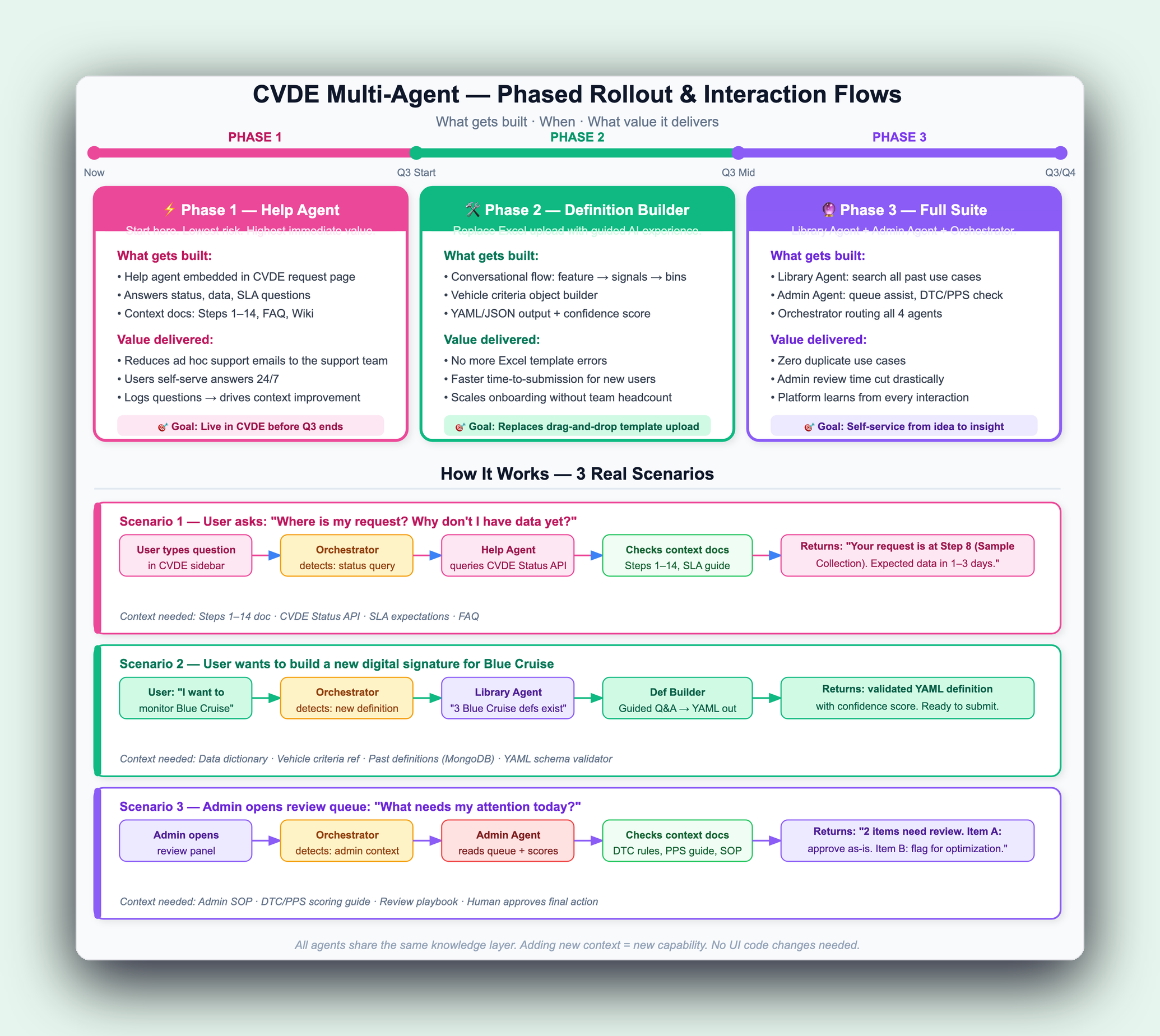
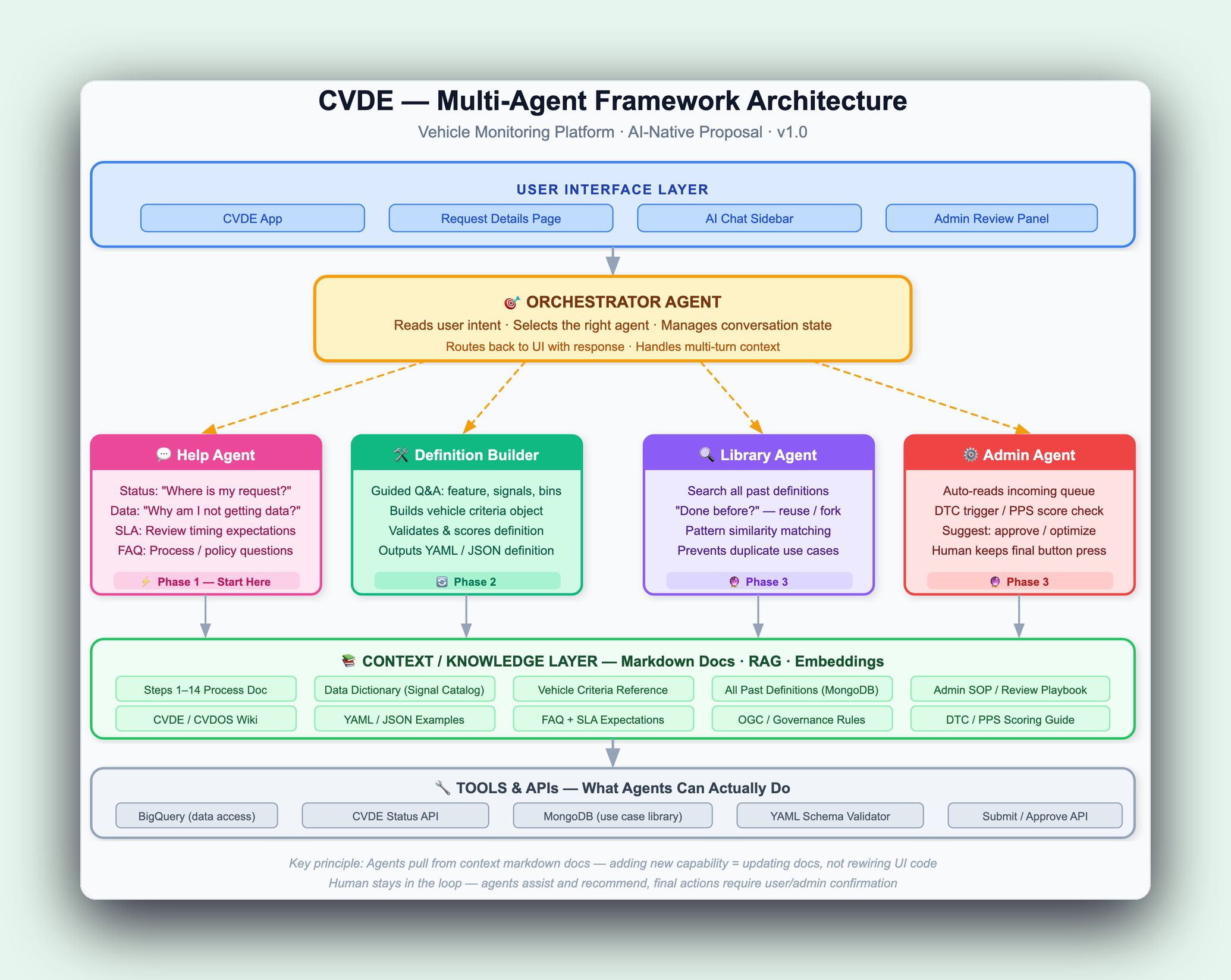
UVMI — a multi-agent platform vision

Problem

The individual tools proved the pattern — but the real leverage is a shared, org-wide way of working.

Decision

Mapped how the pieces scale into a unified set of specialized agents — help, search, request-building, optimization, and more.

Tradeoff

A bigger, longer bet than a single tool — framed as a proposed direction, not a finished build.

Outcome

Presented to leadership as a proposed shared way for the organization to work.

Build 04 · Method

ProtoPilot — a reusable prototyping method

Problem

My process was valuable but locked in my head — every designer re-solved prototyping from scratch.

Decision

Captured it as a reusable skill so any designer, PM, or product owner — with no coding — can turn an 8-question plain-English brief into a working, browser-ready prototype.

Tradeoff

An agentic loop with a quality rubric over ad-hoc prompting: ground in real material → map to a proven UX pattern → detect missing requirements → recommend → build → self-critique → deliver.

Outcome

A repeatable way for non-engineers to produce working prototypes — presented to leadership as a proposed standard.

Outcome & impact

Design that ships.

Weeks → Days
prototyping cycles — designers build and test with real users themselves
Hours → Min
template creation for engineers
Production
a shipped AI tool in engineers' hands — not a mockup
Org-wide
reusable method, no coding required — proposed to leadership as a standard
  • Prototypes now arrive engineer-ready, freeing build capacity instead of consuming it.
  • A production AI assistant in daily engineering use — grounded, validated, and testable.
  • A repeatable method that lets non-engineers produce working prototypes in hours.
Reflection

Learning to build made my design decisions testable.

The most valuable thing I can hand a team now isn't a picture of the idea; it's the working idea, plus a blueprint to productionize it.

Building didn't make me less of a designer.

It made my design decisions testable — I can prove an experience works, not just describe it.

The best handoff is a working idea.

A grounded, working prototype plus a productionization blueprint beats a static picture every time.

The direction I keep pushing.

Design that ships — closing the gap between the experience I specify and the software that reaches users.